
Bookkeeping vs Accounting: Understanding the Difference That Impacts Business Growth
Many business owners, start-up founders, and entrepreneurs use the terms bookkeeping and accounting interchangeably. At first glance, they may appear to serve the same purpose, managing a company’s financial records. However, understanding the difference between bookkeeping and accounting is essential for making informed financial decisions, maintaining compliance and driving sustainable business growth.

The confusion often arises because both functions deal with financial data and are closely interconnected. While bookkeeping focuses on recording and organizing day-to-day financial transactions, accounting goes a step further by analysing, interpreting and transforming that data into meaningful financial insights. In simple terms, the bookkeeping and accounting difference lies in their purpose: one creates accurate financial records, while the other helps businesses understand what those records mean.
For modern businesses, especially start-ups and SMEs operating in a competitive environment, financial clarity is no longer optional. Accurate bookkeeping helps ensure organized records, timely reconciliations and smooth compliance processes. Accounting, on the other hand, supports strategic decision-making, tax planning, financial forecasting and long-term business growth. To truly differentiate accounting from bookkeeping, it is important to recognize that both functions work together to create a strong financial foundation.
In this comprehensive blog on bookkeeping vs accounting, we will explore the key distinctions, responsibilities, benefits and how choosing the right financial support can help your business achieve greater efficiency and success.
What is Bookkeeping?
It is the process of systematically recording, organizing and maintaining a business’s financial transactions on a day-to-day basis. It serves as the foundation of an organization’s financial management system, ensuring that every financial activity is accurately documented and readily available for review. Before businesses can generate meaningful financial reports or make strategic decisions, they must first establish accurate records through effective bookkeeping.

Simply put, bookkeeping involves tracking the money flowing into and out of a business. Whether it is a sales transaction, vendor payment, employee salary, or operational expense, every financial activity must be properly recorded. This organized financial data forms the basis for accounting, taxation, compliance and financial analysis.
The key responsibilities typically include:
- Recording daily financial transactions
- Managing customer and vendor invoices
- Tracking business expenses and income
- Maintaining accurate ledgers and financial records
- Performing bank reconciliations
- Recording payroll and employee-related entries
- Managing accounts payable and accounts receivable
- Organizing supporting financial documents
The primary objective of bookkeeping is to ensure daily financial data accuracy. Even a minor error in recording transactions can impact financial reports, tax filings and business decision-making. Therefore, businesses that maintain accurate bookkeeping practices are better positioned to manage cash flow, comply with regulatory requirements and gain a clear understanding of their financial health.
In the broader discussion of bookkeeping vs accounting, bookkeeping acts as the first and most crucial step, providing the reliable financial information that accountants use for analysis, reporting and strategic planning. For information regarding the services for it, you can read our dedicated page on Bookkeeping services.
What is Accounting?
It is the process of systematically recording, organizing and maintaining a business’s financial transactions on a day-to-day basis. It serves as the foundation of an organization’s financial management system, ensuring that every financial activity is accurately documented and readily available for review. Before businesses can generate meaningful financial reports or make strategic decisions, they must first establish accurate records through effective bookkeeping.

Simply put, bookkeeping involves tracking the money flowing into and out of a business. Whether it is a sales transaction, vendor payment, employee salary, or operational expense, every financial activity must be properly recorded. This organized financial data forms the basis for accounting, taxation, compliance and financial analysis.
The key responsibilities typically include:
- Preparing financial statements such as Profit & Loss Statements, Balance Sheets and Cash Flow Statements
- Tax planning and tax compliance management
- Conducting financial analysis to assess business performance
- Budgeting and financial forecasting
- Ensuring compliance with statutory and regulatory requirements
- Providing audit support and preparing audit-related documentation
- Offering business advisory and strategic financial recommendations
- Identifying opportunities for cost optimization and profitability improvement
Unlike bookkeeping, which focuses primarily on maintaining accurate financial records, accounting is more analytical and decision-oriented. Accountants use financial data to uncover trends, measure performance and provide actionable insights that help businesses achieve their objectives.
In essence, accounting converts financial records into valuable business intelligence, making it an indispensable function for organizations seeking sustainable growth, effective compliance management and long-term financial success. For detailed information regarding it, you can go through our comprehensive page on Accounting and Outsourcing services.
Difference between Bookkeeping and Accounting
Although bookkeeping and accounting are closely related and work together to support a business’s financial management, they are not the same. Understanding the difference between bookkeeping and accounting is crucial for business owners, start-ups and SMEs seeking better financial control and informed decision-making.
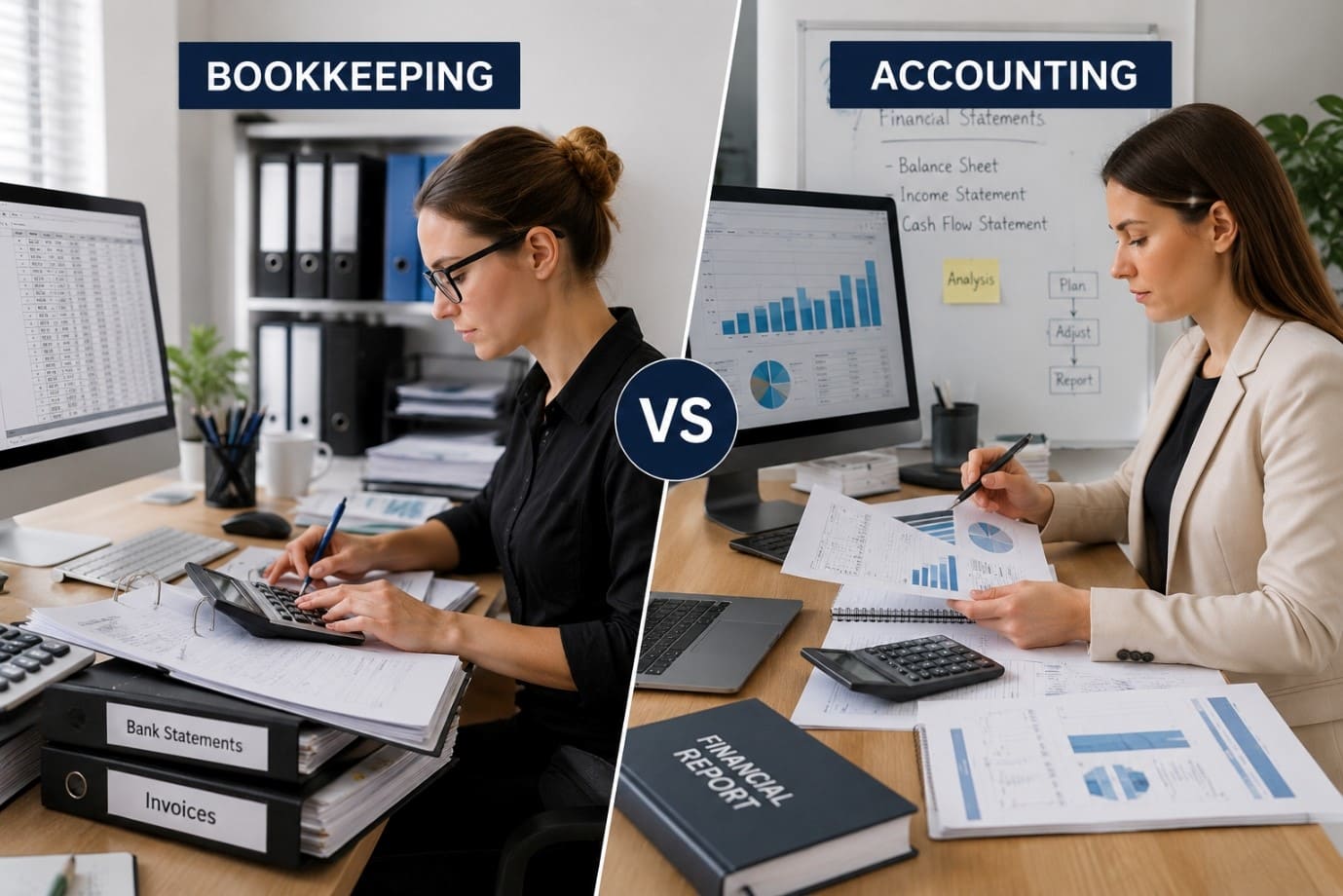
At a fundamental level, bookkeeping focuses on accurately recording financial transactions, while accounting involves analysing and interpreting that financial information to provide strategic insights. To truly differentiate accounting from bookkeeping, it is important to understand that bookkeeping forms the foundation upon which accounting is built.
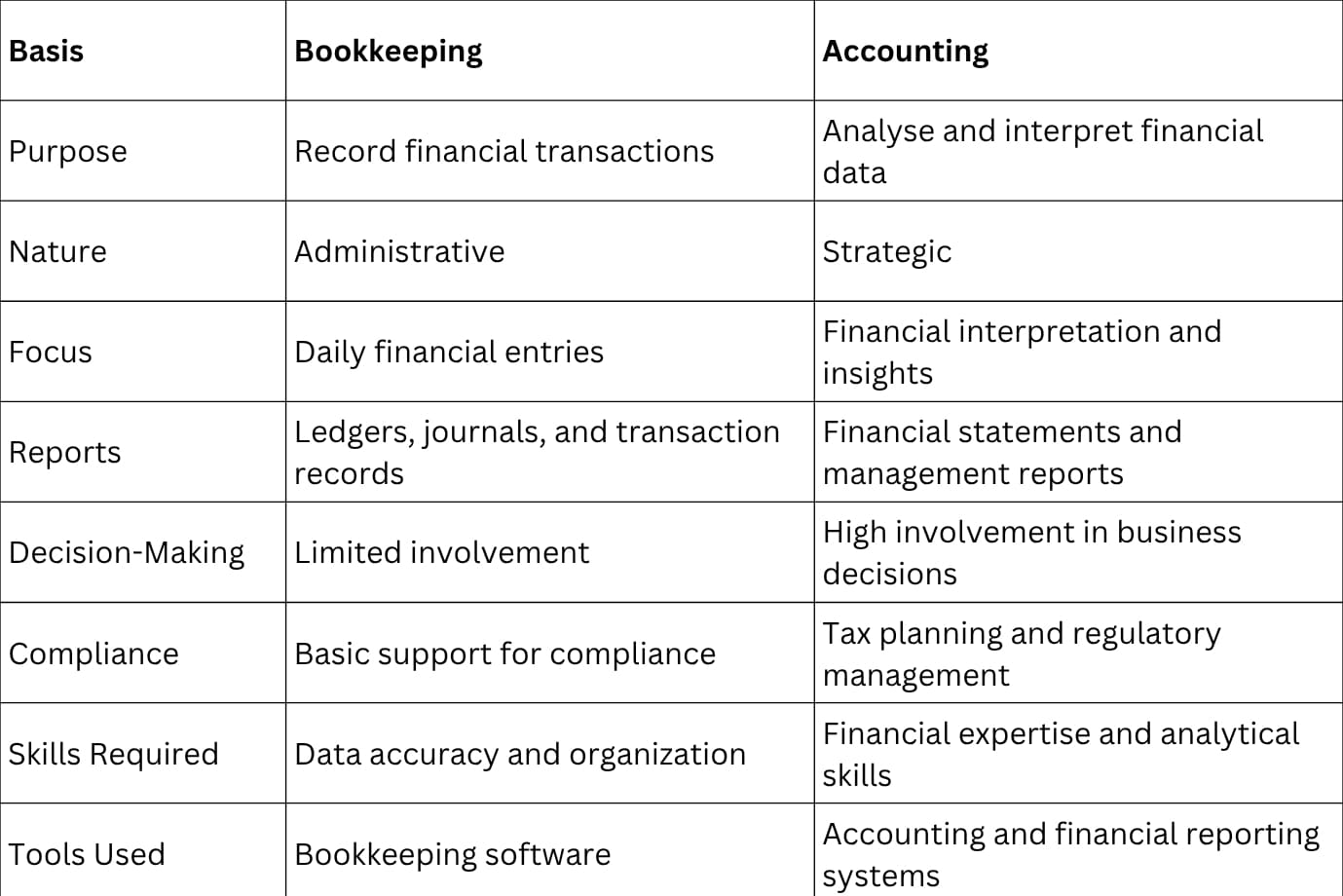
Operational Role vs Strategic Role
- One of the most significant aspects of the bookkeeping and accounting difference is the role each function plays within an organization. Bookkeeping is primarily operational. It focuses on maintaining accurate financial records and ensuring that all transactions are properly documented. Without reliable bookkeeping, businesses may struggle with incomplete records, reporting errors and compliance issues.
- Accounting, however, is strategic in nature. Accountants evaluate financial information to identify trends, measure profitability, assess financial risks and support long-term business planning. Their insights help management make informed decisions regarding investments, expansion, budgeting and resource allocation.
Historical Data vs Future Planning
- Another important way to understand the difference between bookkeeping and accounting is by examining their approach to financial data.
- Bookkeeping is largely concerned with historical information. It records what has already happened within the business, including sales, purchases, expenses and payments.
- Accounting not only reviews historical data but also uses it to forecast future performance. Through budgeting, financial analysis and forecasting, accountants help businesses prepare for upcoming challenges and opportunities. This future-focused perspective makes accounting an essential tool for sustainable growth.
Recording vs Interpreting Financial Information
- When businesses attempt to differentiate accounting from bookkeeping, they often overlook the distinction between recording and interpretation.
- Bookkeepers ensure that financial data is collected, categorized, and maintained accurately. Their primary responsibility is to create a reliable financial record system.
- Accountants take those records and interpret what they mean for the business. They prepare financial statements, analyse financial performance, identify areas of improvement and provide recommendations that support strategic objectives.
Ultimately, the bookkeeping vs accounting comparison is not about choosing one over the other. Both functions serve distinct yet complementary purposes. While bookkeeping ensures accuracy and organization, accounting transforms financial data into actionable insights. Together, bookkeeping and accounting provide the financial clarity, compliance support, and strategic direction businesses need to achieve long-term success.
Why Both Bookkeeping and Accounting Matter?
Understanding the difference between bookkeeping and accounting is important, but recognizing how these two functions work together is even more critical for business success. While bookkeeping ensures that financial transactions are accurately recorded, accounting transforms that data into meaningful insights that support strategic decision-making. In reality, businesses need both functions to maintain financial stability, ensure compliance, and achieve sustainable growth.
Without accurate bookkeeping, accounting lacks reliable data to analyse. Similarly, without accounting, businesses may have organized financial records but no clear understanding of their financial performance or future direction. This is why bookkeeping and accounting are often viewed as two sides of the same coin.
When integrated effectively, bookkeeping and accounting help businesses:
- Maintain healthy cash flow through accurate income and expense tracking
- Ensure compliance with tax laws and regulatory requirements
- Support accurate tax calculations and timely tax filings
- Improve financial transparency and reporting accuracy
- Build investor and stakeholder confidence through reliable financial statements
- Enable informed budgeting, forecasting and business growth planning
- Identify financial risks and opportunities before they impact operations
For start-ups and SMEs, the value of combining bookkeeping and accounting is even greater. Growing businesses often operate with limited resources and face increasing compliance obligations. A strong financial management framework allows founders to focus on growth while maintaining control over their finances.
Many businesses struggle to differentiate accounting from bookkeeping and may unintentionally prioritize one over the other. However, the true advantage lies in leveraging both functions together. This is where outsourced finance teams, professional accounting support and Virtual CFO services can play a significant role. By bridging the gap between operational financial management and strategic financial planning, businesses gain access to accurate records, actionable insights and expert guidance that support long-term success. For more details, you can also go through our dedicated page on Virtual CFO services.
Ultimately, the bookkeeping vs accounting debate should not be about choosing one function over the other. The real value comes from understanding the bookkeeping and accounting difference and using both as part of an integrated financial management strategy that drives compliance, profitability and growth.
Can a Bookkeeper and Accountant Be the Same Person?
One of the most common questions business owners ask when exploring bookkeeping vs accounting is whether a single professional can perform both roles. The answer is yes, but it largely depends on the size, complexity and stage of the business.
In small businesses and early-stage start-ups, it is not uncommon for a single bookkeeper and accountant to manage both functions. Since transaction volumes are relatively low and financial processes are less complex, one qualified professional may be able to handle daily bookkeeping tasks while also preparing financial reports, managing tax requirements and providing basic financial guidance.
However, understanding the difference between bookkeeping and accounting becomes increasingly important as a business grows. With expanding operations, higher transaction volumes, multiple compliance requirements and more complex financial decisions, the responsibilities of bookkeeping and accounting often require specialized expertise. At this stage, businesses may need dedicated professionals to ensure both operational accuracy and strategic financial oversight.
Modern technology has also transformed the way bookkeeping and accounting are managed. Cloud accounting platforms, automated bookkeeping software and real-time reporting tools have streamlined many routine tasks, making financial management more efficient than ever before. While these technologies help automate data entry and reporting, they cannot replace professional judgment, strategic analysis or regulatory expertise.
To truly differentiate accounting from bookkeeping, it is important to recognize that bookkeeping focuses on maintaining accurate records, while accounting focuses on interpreting those records and guiding business decisions. This distinction highlights the bookkeeping and accounting difference that technology alone cannot bridge.
Ultimately, while one professional may manage both functions in smaller organizations, growing businesses benefit significantly from expert oversight. Professional accounting support ensures compliance, reduces financial risks, and provides the strategic insights necessary for sustainable growth. This is why the bookkeeping vs accounting discussion is less about choosing one role and more about ensuring that both functions are adequately supported as the business evolves.
When Should You Outsource Bookkeeping & Accounting?
As businesses grow, managing finances becomes increasingly complex. While many start-ups and small businesses initially handle financial tasks internally, there comes a point when outsourcing becomes a strategic necessity rather than a convenience. Understanding the difference between bookkeeping and accounting can help business owners recognize when they need external expertise to support both operational efficiency and financial decision-making.
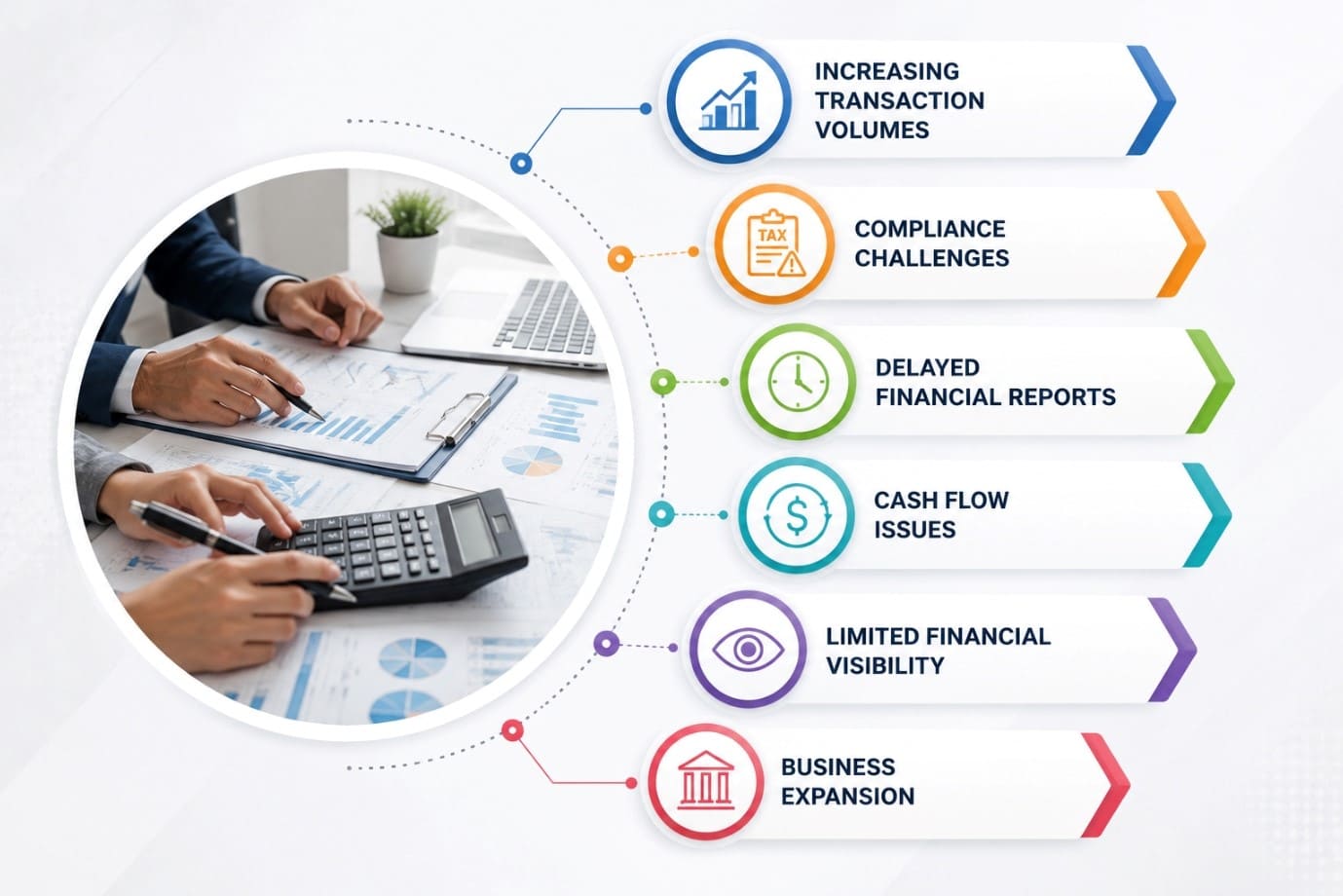
Several signs indicate that it may be time to outsource bookkeeping and accounting functions:

- Increasing transaction volumes that are becoming difficult to manage internally
- Frequent compliance challenges related to taxation and regulatory filings
- Delayed financial reports that hinder timely decision-making
- Persistent cash flow management issues
- Limited visibility into the company's financial performance
- Business expansion plans that require stronger financial controls and strategic guidance
When these challenges arise, relying on an internal bookkeeper and accountant or a small finance team may no longer be sufficient. Outsourcing provides access to specialized expertise while allowing business owners to focus on core operations and growth initiatives.
Benefits of Outsourcing Bookkeeping and Accounting
The benefits of outsourcing bookkeeping and accounting include:
- Improved cost efficiency compared to building a full in-house finance department
- Access to experienced accounting and compliance professionals
- Enhanced regulatory and tax compliance
- Scalable financial support as the business grows
- Greater accuracy in financial reporting and record-keeping
- Timely insights for strategic decision-making
Many businesses initially focus on the bookkeeping and accounting difference when deciding which services to outsource. However, the real value lies in integrating both functions under a professional financial management framework.
Ultimately, the bookkeeping vs accounting discussion should not be viewed as a choice between two functions. Businesses that successfully differentiate accounting from bookkeeping understand that both are essential and outsourcing can be one of the most effective ways to ensure each function receives the attention and expertise it deserves.
Conclusion:
Understanding the difference between bookkeeping and accounting is crucial for businesses seeking better financial control and sustainable growth. While both functions are closely connected, the bookkeeping and accounting difference lies in their purpose and scope. Bookkeeping focuses on recording and maintaining accurate financial transactions, whereas accounting analyses that information to support informed business decisions.
Many business owners struggle to differentiate accounting from bookkeeping, often assuming they perform the same role. However, effective bookkeeping and accounting work together to provide both operational accuracy and strategic financial insight. A skilled bookkeeper and accountant help businesses maintain organized records, ensure compliance, manage taxes and plan for future growth.
The bookkeeping vs accounting discussion is not about choosing one over the other, it is about understanding how both contribute to a strong financial foundation. Accurate bookkeeping provides reliable data, while accounting transforms that data into actionable insights that drive business performance.
Ultimately, businesses that invest in structured financial management are better positioned to improve profitability, maintain compliance, manage risks and seize growth opportunities. By leveraging both bookkeeping and accounting effectively, organizations can build a stronger, more resilient future. For more details, go to our Homepage.
Frequently Asked Questions (FAQs)
Q1.How do bookkeeping and accounting work together?
A. Bookkeeping and accounting are interconnected processes. Bookkeeping records financial transactions and maintains organized records, while accounting uses that information to generate reports, evaluate financial performance and support strategic planning. This relationship highlights the importance of understanding bookkeeping vs accounting..
Q2. Do start-ups need both bookkeeping and accounting services?
A. Yes, start-ups benefit significantly from both bookkeeping and accounting. Accurate bookkeeping helps maintain organized financial records, while accounting provides financial insights, tax planning and forecasting. Understanding the bookkeeping and accounting difference helps start-ups establish strong financial systems from the beginning.
Q3. What are the benefits of outsourcing bookkeeping and accounting?
A. Outsourcing bookkeeping and accounting provides access to experienced professionals, improved compliance, accurate reporting and cost-effective financial management. Businesses that understand the difference between bookkeeping and accounting often choose outsourced solutions to ensure both functions are managed efficiently.
Q4. How does bookkeeping support accounting?
A. Bookkeeping supports accounting by providing accurate and up-to-date financial data. Without proper bookkeeping, accountants may struggle to prepare financial statements, analyse performance or ensure compliance. This relationship is a key aspect of the bookkeeping vs accounting discussion.
Q5. Can accounting be done without bookkeeping?
A. No, accounting cannot be effectively performed without bookkeeping. Since accounting relies on accurate financial records, bookkeeping serves as the foundation for financial analysis and reporting. This is one of the most important aspects of the bookkeeping and accounting difference.


Leave A Comment