
Outsourced Accounting- Why it Matters Today
Over the past decade, accounting has undergone a major transformation. What was once handled entirely through traditional in-house accounting teams, spreadsheets, and manual processes has steadily shifted toward cloud-based systems and specialized external support. Businesses today operate in faster, more complex environments, and this evolution has made outsourced accounting not just an option, but a strategic necessity.

Modern organizations face increasing pressure from complex tax regulations, evolving compliance requirements, and the demand for real-time financial reporting. Managing these challenges internally often requires deep expertise, constant training, and significant investments in technology. At the same time, the cost of hiring, retaining, and scaling skilled finance professionals continues to rise, making internal finance teams expensive and difficult to maintain—especially for growing businesses.
This is where the accounting outsourcing concept comes into play. But what outsourced accounting really is? At its core, it is a model where businesses partner with external experts to manage part or all of their accounting and finance functions. When explained clearly, it becomes evident that this approach goes beyond cost savings—it delivers scalability, expertise, and access to modern accounting tools without the overhead of a full internal team.
From startups and SMBs looking to control costs, to scaling companies seeking flexibility, and even enterprises aiming to improve ROI, outsourced accounting has become a powerful solution. This blog is designed for business leaders, founders, and finance decision-makers who want to understand how outsourcing accounting can support sustainable growth, efficiency, and smarter financial management in today’s competitive landscape.
What Is Outsourced Accounting and How It Works
At its core, outsourced accounting is a business model where companies delegate accounting responsibilities to external accounting providers. This form of third party accounting allows businesses to access professional accounting expertise without maintaining a full in-house department. The accounting outsourcing concept focuses on efficiency, scalability, and accuracy, making it an attractive alternative to traditional accounting structures.
Outsourced accounting can support routine transactional work as well as higher-level financial functions. Depending on business needs, it can operate as an extension of the internal team or fully replace internal accounting operations through outsourced accounting.
- Delegating Accounting Tasks to External Specialists: With outsourced accounting, businesses transfer specific accounting tasks or entire processes to qualified professionals outside the organization. These tasks may include bookkeeping, accounts payable, payroll, reconciliations, tax preparation, and financial reporting. By engaging external accounting providers, companies gain access to specialized skills, industry knowledge, and proven best practices that are often difficult or expensive to maintain internally.
- Partial vs Full Finance Outsourcing: One of the strengths of the accounting outsourcing concept is flexibility. In a partial outsourcing model, only selected activities—such as payroll or accounts payable—are handled externally, while strategic control remains in-house. In contrast, full finance function outsourcing involves an end-to-end outsourced team managing all accounting operations, from daily transactions to management reporting and compliance.
- Common Outsourced Accounting Arrangements: Typical outsourcing arrangements vary based on company size and complexity. Startups may outsource bookkeeping and tax compliance, while growing businesses often outsource AP, AR, and month-end close. Larger organizations may adopt a comprehensive accounting delivery model that includes controllers, financial analysts, and virtual CFO services. These arrangements provide a complete outsourced accounting overview tailored to business goals.
How Outsourced Accounting Works
The operational side of outsourced accounting follows a structured and transparent workflow designed to ensure accuracy, security, and consistency. This standardized accounting delivery model allows organizations to maintain full visibility and control over their financial data.
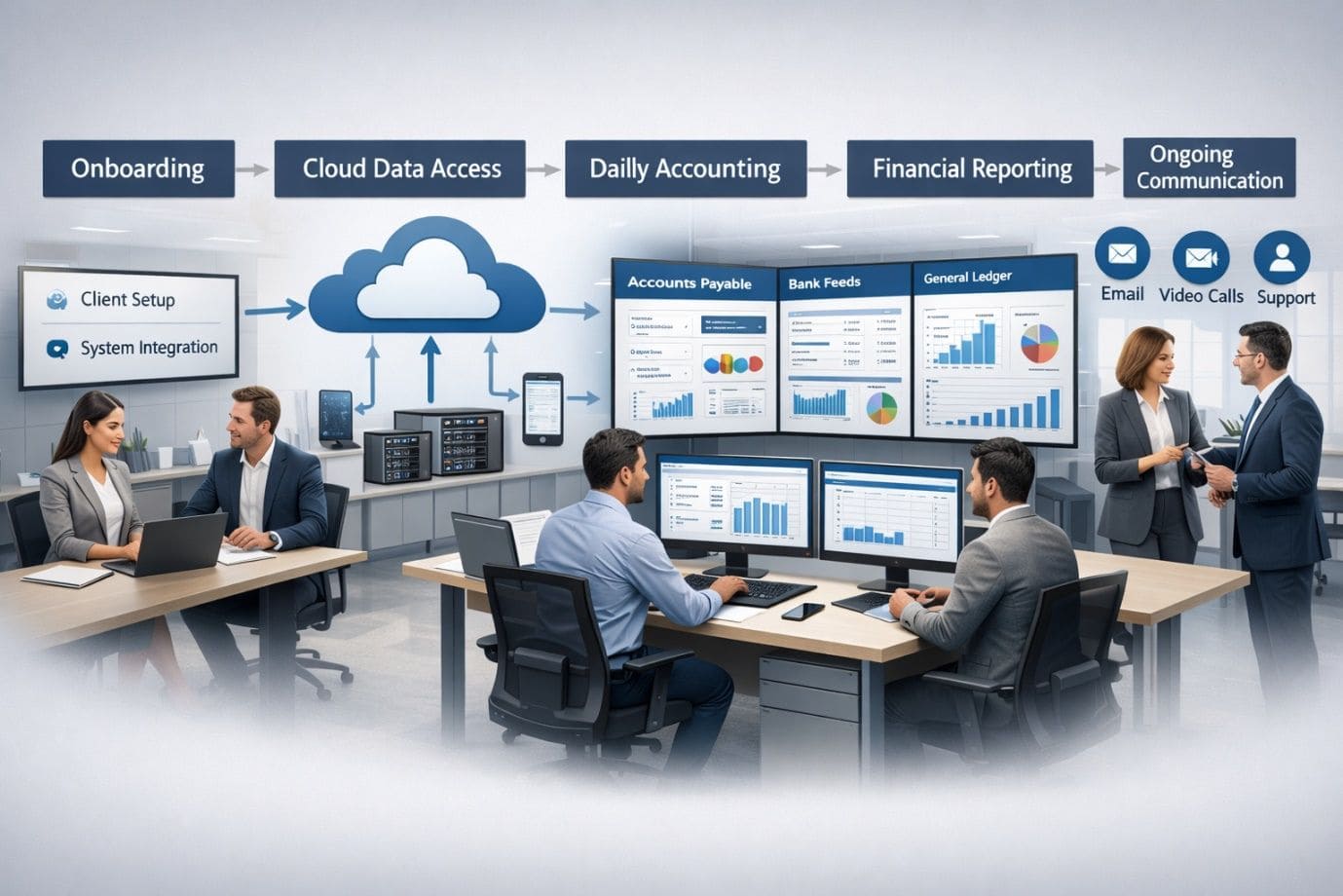
- Initial Assessment and Onboarding: The process begins with an initial assessment where external accounting providers review existing systems, workflows, and compliance requirements. During onboarding, roles, responsibilities, timelines, and reporting expectations are clearly defined to establish a strong foundation for collaboration.
- Data Access and System: access is established through cloud-based platforms. Bank feeds, ERP systems, and accounting software are integrated to enable real-time collaboration. This step is critical in building a seamless overview that supports efficiency and transparency.
- Daily and Monthly Accounting Operations: After setup, the outsourced accounting team manages daily and monthly accounting activities. These include transaction recording, reconciliations, invoice processing, payroll execution, and period-end close activities. Clearly defined workflows ensure consistency and compliance across all processes.
- Reporting and Review Cycles: Regular reporting and review cycles are central to effective outsourced accounting. Financial statements, dashboards, and management reports are delivered on agreed schedules, enabling informed decision-making and continuous performance monitoring.
- Communication and Team Structure: Communication is maintained through structured engagement models. Businesses may work with a dedicated outsourced finance team or a shared services model, depending on scale and complexity. In both cases, regular meetings, defined escalation paths, and clear accountability ensure smooth collaboration.
By combining expert talent, secure technology, and a proven accounting delivery model, outsourced accounting integrates seamlessly into modern finance operations—helping businesses achieve accuracy, scalability, and strategic financial control.
Types of Outsourced Accounting Services
One of the biggest strengths of outsourced accounting is its wide range of service offerings. Businesses can outsource individual accounting tasks or adopt a comprehensive model, depending on their size, complexity, and growth stage. Through third party accounting, organizations gain access to specialized expertise delivered by external accounting providers, all aligned with the broader concept of efficiency and scalability.
Bookkeeping Services
It is often the foundation of outsourced accounting. It includes daily transaction recording to ensure all financial activities are accurately captured. External accounting providers also manage bank and credit card reconciliations to keep records aligned with actual cash movements. In addition, chart of accounts management ensures transactions are categorized correctly, providing a clean structure for financial reporting and analysis.
Also Read: Common Bookkeeping and Accounting Errors in SMEs
Accounts Payable (AP) Outsourcing
AP outsourcing focuses on streamlining how businesses manage outgoing payments. Under third party accounting, invoices are received, verified, and processed efficiently. Vendor management ensures accurate records and timely communication, while payment scheduling helps businesses optimize cash flow and avoid late payment penalties—key benefits of finance function outsourcing.
Accounts Receivable (AR) Outsourcing
AR outsourcing improves how companies manage incoming cash. Outsourced accounting teams handle invoicing, follow up on collections, and manage cash application. This structured approach accelerates cash inflows and improves visibility into outstanding receivables, strengthening overall financial control.
Payroll Outsourcing
Payroll is a critical yet compliance-heavy function. Through external accounting providers, businesses can outsource payroll processing, payroll tax filings, and adherence to labor laws. This reduces compliance risks while ensuring employees are paid accurately and on time.
Financial Reporting & Month-End Close
Accurate reporting is central to the accounting outsourcing concept. These services include preparing monthly, quarterly, and annual financial statements such as balance sheets, profit and loss statements, and cash flow reports. Efficient month-end close processes ensure timely insights for management.
Tax Preparation & Compliance
Tax-related services cover corporate tax filings, GST compliance, and regulatory reporting. Outsourced accounting specialists help businesses meet filing deadlines and stay compliant with evolving tax regulations.
Virtual CFO / Controller Services
At a strategic level, outsourced accounting may include virtual CFO or controller support. These services provide budgeting and forecasting, financial strategy and advisory, and investor or board reporting—turning outsourced accounting into a strategic growth enabler rather than just an operational function. For more information, you can also go through our dedicated page on Virtual CFO.
In-House vs Outsourced Accounting
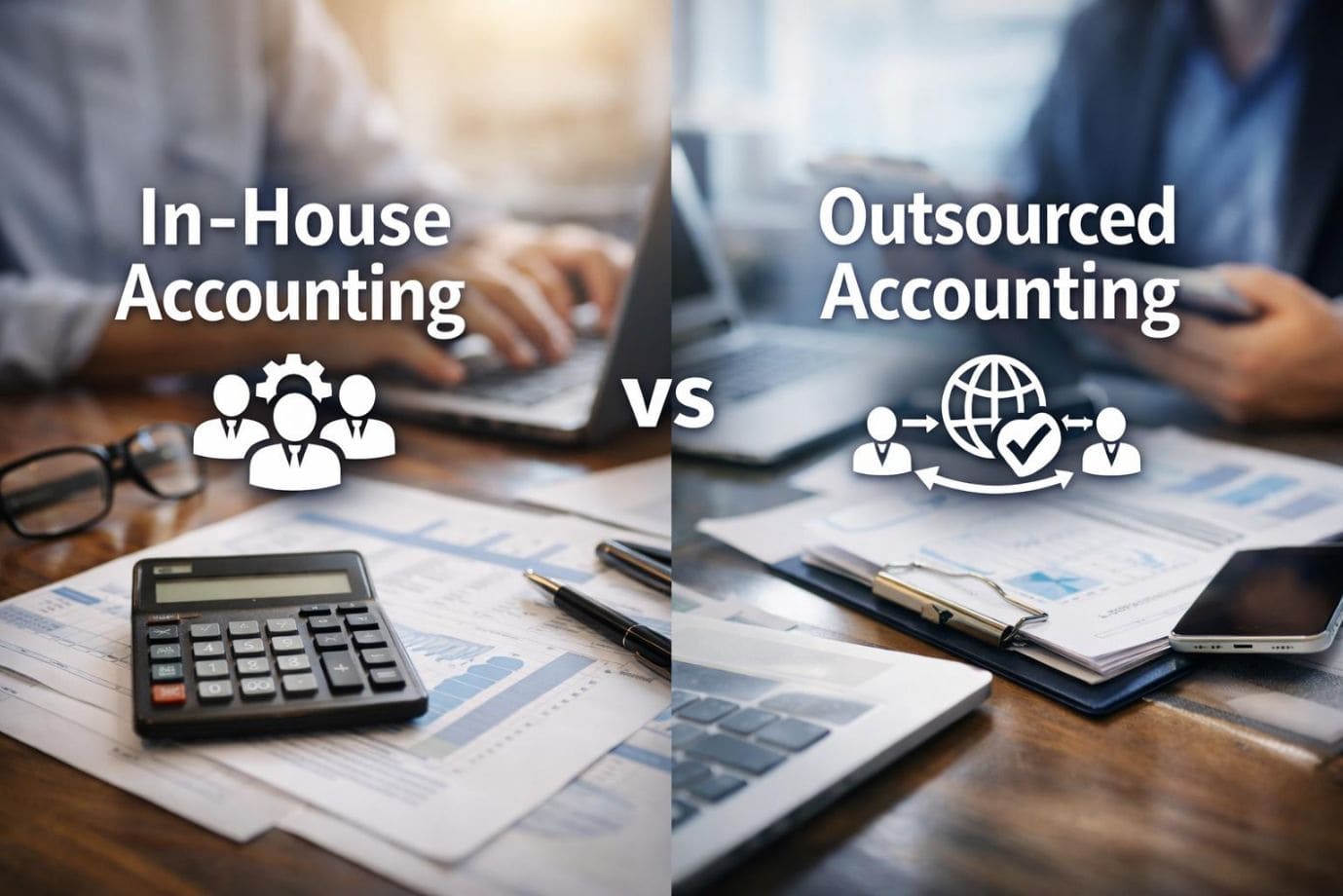
Choosing between in-house and outsourced accounting is a critical decision that directly impacts cost, efficiency, and financial control. Understanding how these two models differ helps businesses select the right approach based on their size, complexity, and long-term goals. This comparison provides a clear view of in-house and outsourced accounting to support informed decision-making.
What Is In-House Accounting?
In-house accounting, also referred to as internal accounting, is a traditional model where all finance and accounting activities are handled by employees within the organization. Businesses build internal teams to manage daily bookkeeping, financial reporting, payroll, tax compliance, and strategic financial planning.
The structure of internal accounting services typically includes multiple roles, depending on company size. A bookkeeper handles daily transactions and reconciliations, an accountant prepares financial statements and ensures compliance, a controller oversees accounting operations and controls, and a CFO provides strategic financial leadership. While in-house accounting offers direct oversight and close alignment with business operations, it also requires significant investment in salaries, benefits, training, and accounting technology.
Key Differences: In-House vs Outsourced Accounting
- Cost
- In –House accounting has high fixed costs due to salaries, benefits, training, and infrastructure.
- While Outsourced accounting has Lower and more flexible costs with predictable pricing.
- Scalability
- In-House accounting has limited scalability; hiring or downsizing takes time.
- Outsourced accounting is easily scalable based on business needs.
- Expertise
- In-House accounting is dependent on individual employees’ skills.
- Outsourced accounting has access to a broad pool of specialized experts.
- Technology
- In-House accounting requires investment in accounting software and systems.
- Outsourced accounting requires advanced tools provided by service partners.
- Risk and Compliance
- In-House accounting has higher risk if internal expertise is limited.
- Outsourced accounting has strong compliance support through specialized. teams
- Speed and Efficiency
- Processes may slow during peak periods in In-House accounting.
- Outsourced accounting has streamlined workflows and faster turnaround times.
- Advantages
- In-House accounting provides direct control and immediate communication.
- Outsourced accounting has cost efficiency, flexibility, and expert access.
- Limitations
- In-House accounting includes high costs, talent dependency, limited flexibility.
- Outsourced accounting requires strong vendor selection and governance.
By comparing internal accounting with outsourced accounting, businesses can clearly see how outsourcing delivers flexibility, scalability, and cost efficiency—making it an increasingly preferred model in today’s dynamic business environment.
How Outsourcing Reduces Finance Costs
One of the strongest business cases for outsourced accounting is its ability to significantly reduce finance costs without compromising accuracy or compliance. By shifting from fixed internal cost structures to flexible service-based models, businesses achieve measurable cost reduction and long-term efficiency gains.
- Lower Staffing and Hiring Costs: With outsourced accounting, companies eliminate the need for recruiting, onboarding, and training internal finance staff. There are no ongoing expenses for salaries, benefits, bonuses, or attrition-related costs. This immediately delivers substantial cost savings, especially for businesses that would otherwise need to hire multiple accounting specialists.
- Reduced Infrastructure and Technology Costs: Outsourcing removes the burden of maintaining office space, accounting software licenses, and IT infrastructure. Service providers supply secure systems, tools, and platforms as part of the engagement, further driving outsourcing accounting cost reduction while ensuring access to modern technology.
- Pay Only for What You Use: Another major advantage is pricing flexibility. Businesses pay only for the services they need—whether monthly, per transaction, or per process. This allows easy scaling during growth or seasonal demand, improving accounting outsourcing ROI by aligning costs directly with usage.
- Improved Efficiency Through Automation: External providers leverage automation to speed up processing, reduce manual errors, and minimize rework. Faster workflows and lower error rates help avoid penalties, contributing to higher cost savings from outsourced accounting.
- Fewer Compliance and Penalty Risks: Experienced professionals ensure timely filings and regulatory compliance. By reducing tax errors and late submissions, outsourced accounting helps businesses avoid costly compliance mistakes—maximizing both savings and ROI.
Key Benefits of Outsourced Accounting
Outsourced accounting offers more than operational support—it delivers tangible financial and strategic advantages that help businesses operate more efficiently and grow with confidence. The benefits of outsourced accounting extend across cost management, expertise, scalability, and performance, making it a valuable model for organizations of all sizes.
- Cost Savings: One of the most immediate benefits of outsourced accounting is reduced operational expense. By shifting away from fixed internal costs, businesses achieve measurable benefits and long-term cost savings from outsourced accounting. This model helps organizations reduce finance costs without sacrificing quality or control.
- Access to Experienced Accounting Professionals: With outsourced accounting, businesses gain access to highly skilled professionals across multiple accounting disciplines. These experts bring deep knowledge in compliance, reporting, and best practices—expertise that would otherwise require multiple in-house hires.
- Scalability and Flexibility: Outsourced accounting allows services to scale up or down as business needs change. Whether supporting rapid growth or seasonal demand, this flexibility helps companies maintain efficiency while improving ROI.
- Improved Accuracy and Financial Visibility: Standardized processes and expert oversight enhance accuracy and consistency. Outsourced accounting ensures timely, reliable financial data, giving leadership better visibility into business performance.
- Faster Month-End Close: Automation and dedicated workflows enable faster month-end and year-end close cycles. This allows management teams to access insights sooner and make timely strategic decisions.
- Focus on Core Business Activities: By offloading routine finance tasks, outsourced accounting frees internal teams to focus on innovation, customer engagement, and growth—further strengthening overall ROI.
Common Myths about Outsourced Accounting and the Future Ahead
As outsourced accounting continues to gain traction, several misconceptions still prevent businesses from fully embracing it. At the same time, rapid advancements in technology are reshaping how outsourced finance functions operate. Addressing these myths—and understanding where outsourced accounting is headed—helps organizations make confident, future-ready decisions.
Myth 1: “Outsourced accounting is only for small businesses”
This is one of the most common misconceptions. While startups and SMBs benefit greatly from outsourced accounting, large enterprises also rely on third party accounting for scalability, efficiency, and global operations. Many organizations adopt hybrid models where internal accounting teams focus on strategy while transactional work is outsourced, driving both efficiency and ROI.
Myth 2: “You lose control of your finances”
In reality, outsourcing often improves control and visibility. With defined processes, SLAs, and real-time reporting dashboards, businesses maintain full oversight. Compared to fragmented internal accounting, outsourced models offer standardized workflows and transparency—while still delivering cost reduction.
Myth 3: “Outsourcing compromises data security”
Modern outsourced accounting providers invest heavily in secure cloud platforms, access controls, and compliance frameworks. In many cases, their security standards exceed what small or mid-sized internal accounting teams can maintain independently, making data protection stronger—not weaker.
Myth 4: “Outsourced accountants don’t understand my business”
Specialized providers bring industry-specific expertise and proven best practices. Through onboarding and continuous collaboration, third party accounting teams align closely with business goals while delivering measurable cost savings.
The Future of Outsourced Accounting
Looking ahead, the future of outsourced accounting is being shaped by automation, cloud technology, and global talent access. AI-powered tools are transforming routine tasks such as reconciliations, invoice processing, and reporting—reducing errors and accelerating close cycles. This automation enhances accounting outsourcing cost benefits while improving accuracy and insights.
Cloud-based finance platforms are also driving full-scale finance transformation, enabling seamless collaboration between businesses and service providers. As a result, outsourcing is evolving beyond transactional support into high-value advisory services. Providers are increasingly offering forecasting, financial planning, and strategic guidance—significantly improving ROI.
Additionally, global talent models and shared services are redefining how finance teams are built. By combining onshore oversight with offshore expertise, companies achieve sustainable outsourcing accounting cost reduction while maintaining quality and scalability.
Together, these trends position outsourced accounting as a future-proof alternative to traditional internal accounting, delivering efficiency, insight, and long-term business value.

Conclusion:
In today’s fast-paced and highly regulated business environment, outsourced accounting has emerged as a practical and forward-looking alternative to traditional internal accounting models. As highlighted throughout this blog, outsourcing accounting functions enables organizations to control costs, improve efficiency, and scale operations without the limitations of fixed internal structures. The ability to realize tangible cost savings from outsourced accounting while maintaining accuracy and compliance makes this model especially valuable for growing and evolving businesses.
Beyond cost efficiency, accounting outsourcing cost benefits extend to improved access to skilled professionals, modern cloud-based tools, and streamlined processes. These advantages translate into faster reporting cycles, better financial visibility, and a stronger overall ROI. For businesses facing rising talent costs or operational complexity, outsourcing offers a clear path toward sustainable outsourcing accounting cost reduction and long-term resilience.
As companies reassess their finance strategies, it’s worth considering how outsourcing fits into broader transformation goals. Many professional advisory and accounting firms today provide integrated finance, accounting, and compliance support—helping organizations modernize their finance functions while staying aligned with regulatory and business requirements. Firms like Kamvisors Global LLP, for instance, reflect this evolving approach by combining accounting, tax, and advisory expertise to support businesses at different stages of growth.
Ultimately, evaluating whether outsourced accounting aligns with your operational needs can be a strategic step forward. For more insights and expertise on optimizing your financial operations, feel free to contact us or request a consultation via the resources available on our Homepage.
Frequently Asked Questions (FAQs)
Q1. What is outsourced accounting and how does it work?
A. Outsourced accounting is a business model where companies delegate accounting tasks to external experts instead of relying solely on internal accounting teams. It works through a structured accounting delivery model, where third-party professionals handle bookkeeping, reporting, compliance, and advisory services using secure cloud-based systems.
Q2. How is outsourced accounting different from internal accounting?
A. The main difference between outsourced accounting and internal accounting lies in cost, scalability, and expertise. While internal teams involve fixed salaries and infrastructure, outsourced models offer flexible pricing, broader expertise, and faster scalability—making in-house vs outsourced accounting a key strategic comparison for modern businesses.
Q3. How does outsourced accounting help reduce finance costs?
A. Businesses can reduce finance costs by outsourcing through lower staffing expenses, reduced technology investments, and pay-as-you-use pricing models. These factors contribute directly to outsourcing accounting cost reduction and long-term operational efficiency.
Q4. How secure is outsourced accounting?
A. Modern third party accounting providers use secure cloud platforms, access controls, and compliance frameworks. In many cases, their data security standards are stronger than those maintained by small or mid-sized internal accounting teams. You can also go through our dedicated page on Accounting and Outsourcing services and get comprehensive information for it.
Q5. How do I know if outsourced accounting is right for my business?
A. If your business is experiencing rising finance costs, limited scalability, or reporting delays, outsourced accounting may be a strong fit. Evaluating your current internal accounting setup against outsourcing options can help determine whether this model aligns with your growth and efficiency goals.


Leave A Comment