

Payroll Outsourcing- Benefits, Process and Best Practices
In today’s competitive business landscape, payroll outsourcing has become an essential solution for organizations looking to streamline payroll operations, improve compliance and reduce administrative burdens. Managing payroll involves much more than processing salaries, it requires accurate tax calculations, statutory deductions, compliance reporting, employee benefit administration and adherence to evolving labour laws. As a result, businesses of all sizes are increasingly choosing to outsource payroll services to experienced payroll service providers that can handle these complex responsibilities efficiently. From start-ups to large enterprises, companies are leveraging payroll and outsourcing strategies to improve operational efficiency, minimize payroll mistakes and ensure timely salary disbursements. The growing adoption of payroll outsourcing solutions reflects the need for reliable, scalable and cost-effective payroll management.

For Indian businesses, payroll management is becoming increasingly challenging due to frequent changes in EPF, ESI, Professional Tax, TDS and labour law regulations. Ensuring compliance while maintaining accuracy can consume valuable time and resources. This is particularly true for growing organizations that may lack dedicated payroll teams. Consequently, payroll services for small business have emerged as a practical alternative, enabling companies to access professional payroll expertise without the expense of building an in-house payroll function.
By outsourcing payroll services, businesses can improve payroll accuracy, reduce compliance risks, and enhance employee satisfaction through timely salary processing. In this blog, we will explore how payroll outsourcing works, its key benefits, compliance considerations and why more businesses are partnering with trusted payroll service providers to support sustainable growth and operational excellence.
What is Payroll Outsourcing?
It is the process of delegating payroll-related tasks and responsibilities to specialized payroll service providers who manage salary processing, statutory compliance, tax deductions, employee benefits administration and payroll reporting on behalf of a business. Instead of maintaining an in-house payroll department, organizations choose to outsource payroll services to experienced professionals who ensure payroll accuracy, compliance and timely salary disbursement.
The scope of outsourcing payroll services extends far beyond basic salary calculations. Modern payroll outsourcing solutions typically include employee data management, attendance and leave tracking, payroll computation, payslip generation, EPF and ESI compliance, TDS deductions, statutory filings and management reporting. Businesses that outsource payroll processing can also benefit from advanced payroll technology, automated workflows and expert guidance on regulatory requirements.
For start-ups, SMEs, and growing enterprises, payroll services for small business offer a cost-effective way to access professional payroll expertise without investing in dedicated payroll infrastructure. The combination of payroll and outsourcing helps reduce administrative workload, minimize compliance risks and improve operational efficiency. Understanding how payroll outsourcing works enables businesses to make informed decisions about streamlining payroll functions while focusing on strategic growth initiatives. By partnering with trusted payroll service providers, organizations can ensure accurate payroll management, regulatory compliance and a better experience for both management teams and employees.
Why Payroll Management is Becoming More Complex
As businesses grow and regulations evolve, payroll management has become increasingly challenging. From ensuring compliance with changing laws to managing employee compensation accurately, organizations face several operational hurdles. These challenges are among the primary reasons businesses are opting for outsourcing payroll services to simplify payroll administration and reduce risks.

Frequent Regulatory Changes
Keeping pace with changing regulations is one of the most demanding aspects of payroll management. Businesses must constantly monitor and adapt to:
- Changes in income tax rules and TDS regulations.
- Updates to labour laws, minimum wage requirements and employment policies.
- Modifications in Provident Fund (PF) contribution rates and compliance requirements.
- Changes in Employee State Insurance (ESI) regulations and reporting obligations.
- New government notifications affecting payroll calculations and statutory filings.
Many organizations choose to outsource payroll services to experienced payroll service providers who ensure ongoing compliance with these evolving regulations.
Manual Errors
Manual payroll processing often increases the likelihood of costly mistakes. Common errors include:
- Incorrect salary calculations and payroll computations.
- Wrong tax deductions and statutory contributions.
- Errors in overtime, incentives, bonuses and reimbursements.
- Delayed salary payments due to manual processing delays.
- Inaccurate employee records and payroll reports.
Businesses that outsource payroll processing can leverage automated systems and expert review processes to minimize such errors.
Compliance Risks
Payroll non-compliance can expose businesses to financial and legal consequences, including:
- Penalties for delayed or incorrect statutory filings.
- Legal notices from regulatory authorities.
- Increased scrutiny during payroll and tax audits.
- Reputational damage due to compliance failures.
- Challenges in maintaining audit-ready payroll documentation.
Understanding how payroll outsourcing works helps businesses recognize how professional payroll management reduces compliance-related risks.
Resource Constraints
Payroll administration requires significant time and effort, especially for growing organizations. Common resource challenges include:
- Time-consuming payroll calculations and validations.
- Increased workload for HR and finance teams.
- Managing employee data, attendance and leave records.
- Tracking statutory deadlines and compliance requirements.
- Difficulty scaling payroll operations as the workforce expands.
This is particularly challenging for organizations seeking payroll outsourcing, where internal resources are often limited. By adopting payroll and outsourcing strategies and partnering with trusted providers, businesses can improve efficiency, reduce administrative burdens and focus on growth-oriented activities.
Key Functions Covered Under Payroll Outsourcing Services
Modern payroll outsourcing encompasses much more than salary calculations. By choosing to outsource payroll services, businesses gain access to comprehensive payroll management that ensures accuracy, compliance and operational efficiency. Leading payroll service providers offer end-to-end solutions that simplify payroll administration while reducing the burden on internal HR and finance teams.
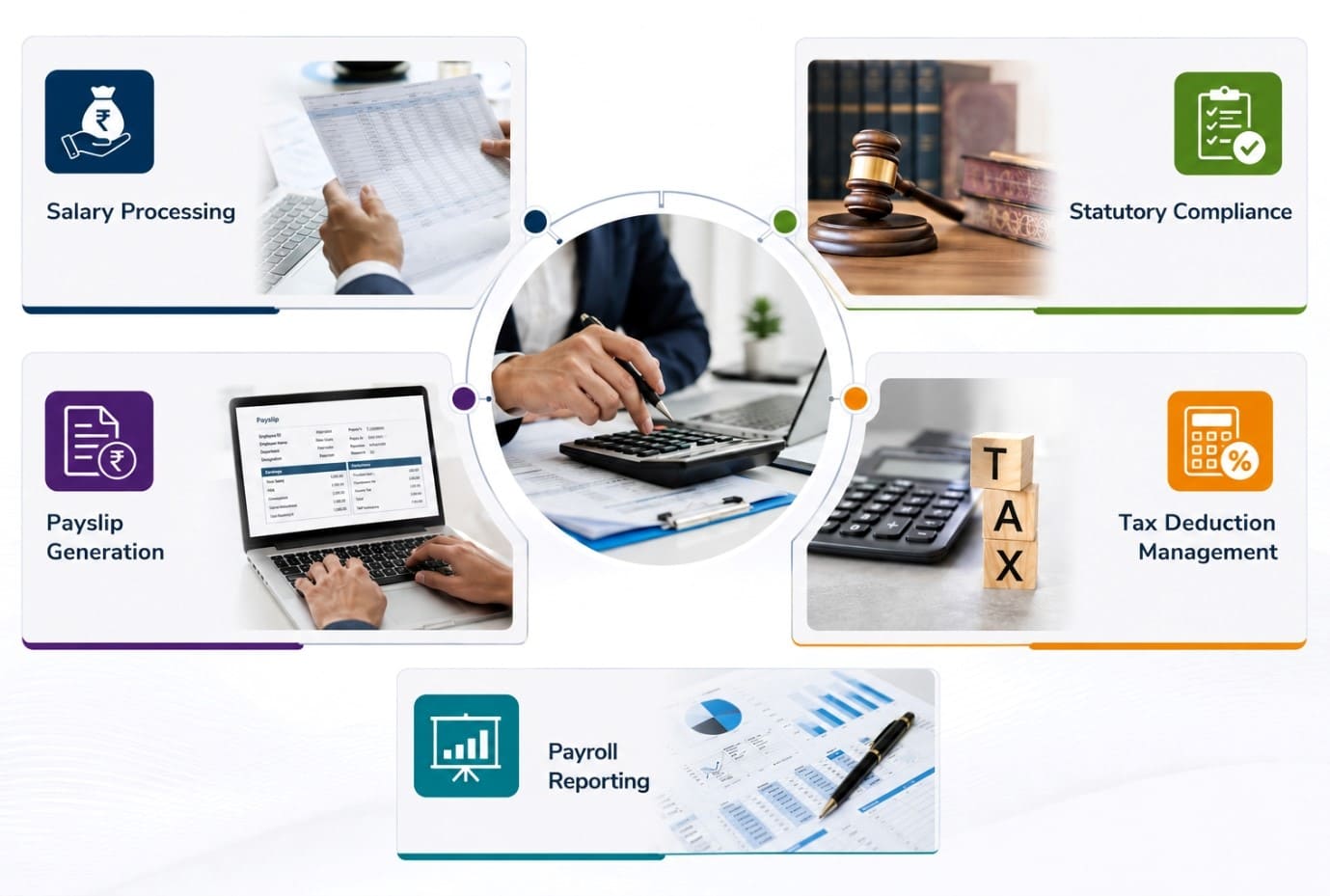
1. Salary Processing
It forms the foundation of effective payroll management and includes:
- Monthly payroll calculations based on employee compensation structures.
- Attendance integration for accurate salary computation.
- Leave management and leave encashment calculations.
- Processing of incentives, bonuses, overtime and reimbursements.
- Timely salary disbursement with minimal errors.
Many organizations outsource payroll services to ensure payroll accuracy and consistency every month.
2. Statutory Compliance
One of the most critical aspects of outsourcing payroll services is ensuring compliance with applicable regulations, including:
- Employees' Provident Fund (EPF) calculations and filings.
- Employee State Insurance (ESI) contributions and reporting.
- Tax Deducted at Source (TDS) compliance.
- Professional Tax calculations and submissions.
- Timely statutory returns and regulatory reporting.
3. Payslip Generation
Advanced payroll outsourcing solutions automate employee payroll documentation through:
- Accurate and automated payslip generation.
- Secure employee access to payroll records.
- Digital distribution of salary statements.
- Maintenance of payroll history and documentation.
4. Tax Deduction Management
Professional payroll service providers assist businesses with:
- Employee income tax calculations.
- Tax-saving declaration management.
- Accurate TDS deductions and reporting.
- Form 16 preparation and distribution.
5. Payroll Reporting
A key advantage of payroll and outsourcing is access to meaningful payroll insights through:
- Detailed MIS reports.
- Payroll cost analysis and workforce reporting.
- Department-wise salary summaries.
- Payroll analytics for better decision-making.
Understanding how payroll outsourcing works helps businesses recognize the value of these integrated services. Whether it is a start-up or an enterprise, payroll services for small business and large organizations alike provide a structured approach to managing payroll while ensuring compliance, efficiency and scalability.
How Payroll Outsourcing Works
Understanding how payroll outsourcing works can help businesses appreciate the value of partnering with professional payroll service providers. Modern payroll outsourcing follows a structured process designed to ensure accuracy, compliance and timely salary disbursement. Whether businesses choose to outsource payroll services for a small team or a large workforce, the process remains systematic and efficient.
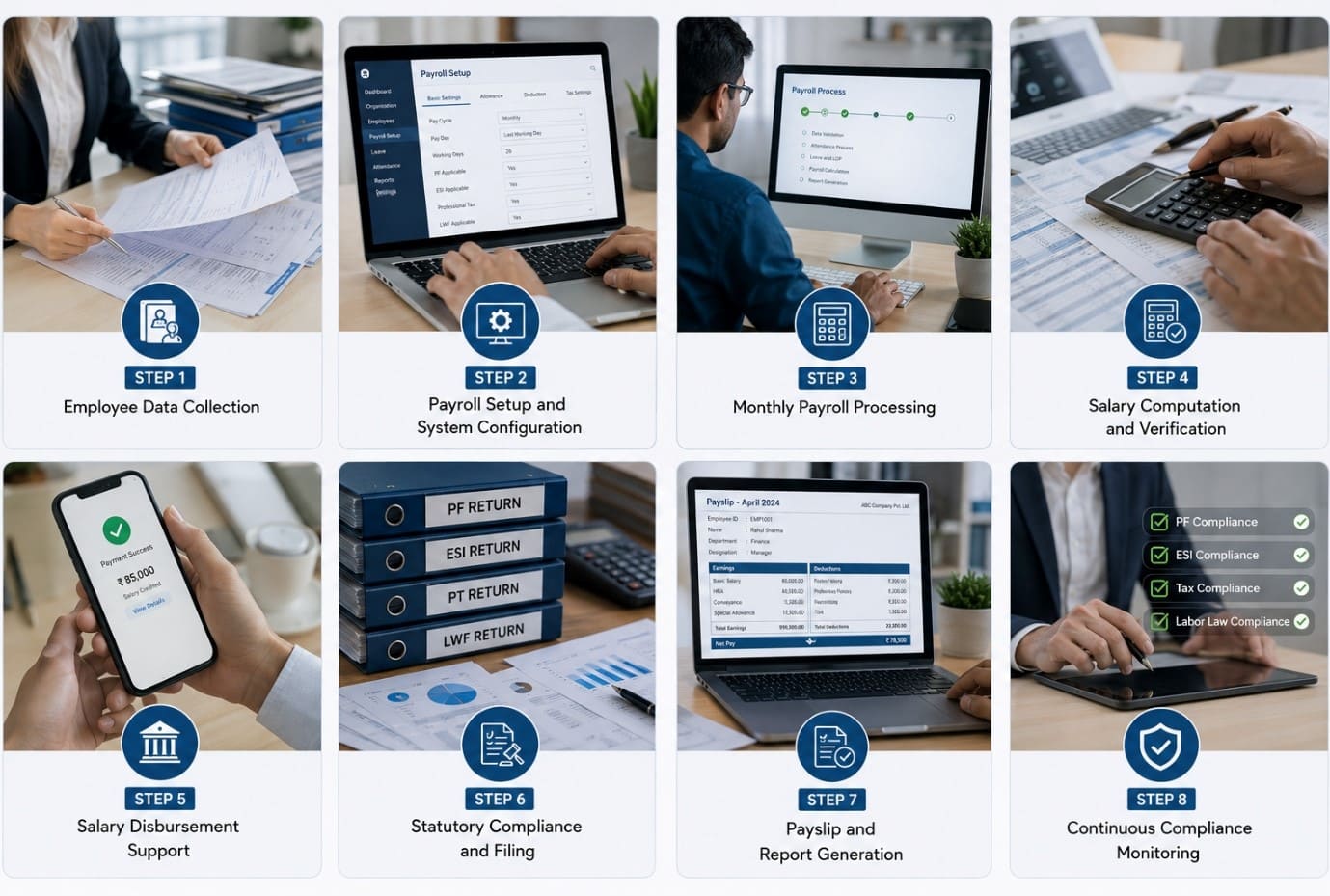
Step 1: Employee Data Collection
The process begins with collecting and organizing essential employee information, including:
- Employee records and personal details
- Salary structures and compensation components
- Tax declarations and investment proofs
- Bank account details for salary transfers
Step 2: Payroll Setup and System Configuration
Once the data is collected, payroll service providers configure payroll systems to align with business requirements.
- Payroll software setup and customization
- Compliance mapping based on applicable regulations
- Configuration of salary heads, allowances and deductions
- Employee master data creation
Step 3: Monthly Payroll Processing
At the beginning of each payroll cycle, all payroll-related inputs are reviewed and updated.
- Attendance verification
- Leave adjustments and leave encashment calculations
- Processing incentives, bonuses, and reimbursements
- Overtime calculations and variable pay adjustments
Many businesses outsource payroll services to ensure these tasks are handled accurately every month.
Step 4: Salary Computation and Verification
After gathering payroll inputs, salary calculations are performed and verified.
- Gross salary calculation
- EPF, ESI, Professional Tax and TDS deductions
- Net salary computation
- Payroll validation and approval checks
Step 5: Salary Disbursement Support
Once payroll is approved, salary payments are prepared for processing.
- Generation of bank transfer files
- Payment scheduling and processing support
- Verification procedures to ensure payment accuracy
Step 6: Statutory Compliance and Filing
A key component of outsourcing payroll services is ensuring statutory compliance.
- EPF return preparation and filing
- ESI reporting and submissions
- TDS return filing
- Labour law and payroll compliance management
Step 7: Payslip and Report Generation
Modern payroll outsourcing solutions provide detailed payroll documentation and reporting.
- Automated employee payslips
- Payroll summaries and reconciliation reports
- MIS reports for management review
- Payroll analytics and workforce cost insights
Step 8: Continuous Compliance Monitoring
Leading payroll service providers continuously monitor regulatory developments to keep businesses compliant.
- Tracking regulatory updates
- Maintaining audit-ready payroll records
- Documentation support and compliance reviews
- Ongoing payroll process improvements
Payroll Outsourcing Workflow
Employee Data ➜ Payroll Processing ➜ Compliance Checks ➜ Salary Disbursement ➜ Reporting
This structured approach explains how payroll outsourcing works and why organizations increasingly adopt payroll and outsourcing strategies. From start-ups seeking payroll outsourcing to large enterprises, businesses that outsource payroll services gain access to expert support, improved compliance, operational efficiency and scalable solutions that simplify payroll management.
Common Payroll Challenges Faced by Businesses
Managing payroll efficiently is becoming increasingly difficult for businesses due to evolving regulations, growing workforce demands and administrative complexities. These challenges often encourage organizations to explore payroll outsourcing and partner with professional payroll service providers to streamline payroll operations.
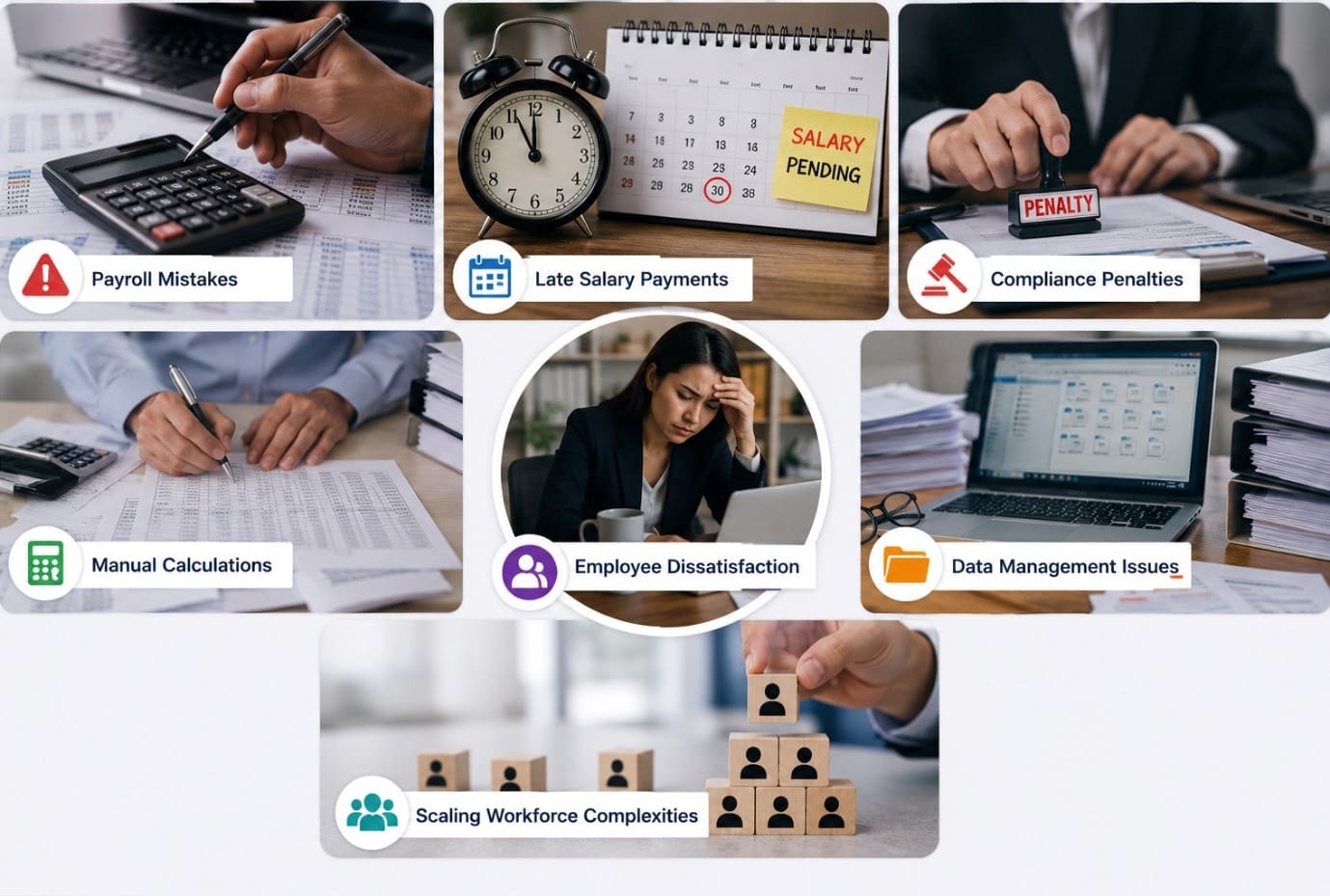
- Payroll Mistakes: These are among the most common challenges businesses face. Incorrect salary calculations, inaccurate deductions and mistakes in overtime or bonus payments can create financial discrepancies and reduce employee trust. Businesses that outsource payroll services can significantly reduce the risk of such errors through automated systems and expert oversight. For detailed information, you can go through our dedicated blog on Common Payroll Errors.
- Late Salary Payments: Delayed salary disbursements can negatively impact employee morale and productivity. Manual payroll processes, incomplete employee data and inefficient workflows often contribute to payment delays. By choosing to outsource payroll services, businesses can ensure timely and accurate salary processing every month.
- Compliance Penalties: Failure to comply with statutory requirements such as EPF, ESI, TDS and Professional Tax regulations can result in penalties, legal notices and financial liabilities. Professional payroll outsourcing solutions help organizations stay compliant and avoid costly regulatory consequences.
- Manual Calculations: Many businesses still rely on spreadsheets and manual payroll calculations, which are time-consuming and prone to errors. As workforce sizes increase, manual payroll management becomes difficult to maintain, making outsourcing payroll services a more efficient alternative.
- Employee Dissatisfaction: Payroll inaccuracies, delayed payments and lack of transparency can lead to employee dissatisfaction. Reliable payroll and outsourcing practices help ensure employees receive accurate salaries, deductions and payslips, improving overall employee experience.
- Data Management Issues: Maintaining employee records, attendance data, salary revisions and payroll documents can become overwhelming without proper systems in place. Experienced payroll service providers offer structured processes and technology-driven solutions to manage payroll data securely and efficiently.
- Scaling Workforce Complexities: As businesses grow, payroll administration becomes more complex due to increased employee numbers, multiple salary structures and diverse compliance requirements. This is especially true for organizations seeking payroll outsourcing that are expanding rapidly. Understanding how payroll outsourcing works enables businesses to scale payroll operations effectively while leveraging the benefits of modern payroll outsourcing solutions.
In-House Payroll vs Payroll Outsourcing: Which is Better?
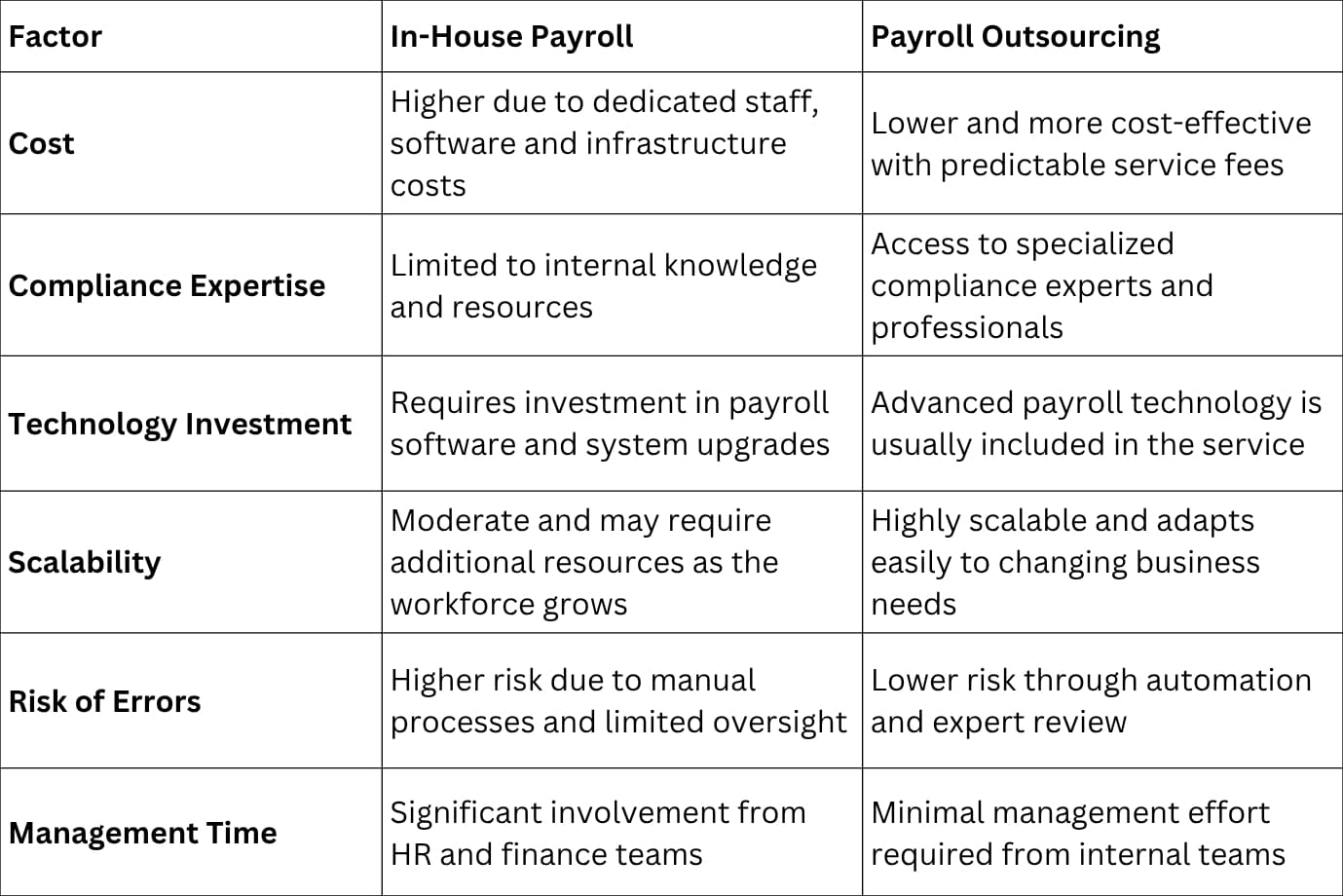
When it comes to payroll management, businesses can either manage payroll internally or partner with professional payroll service providers. While both approaches have their advantages, factors such as cost, compliance requirements, technology investments and scalability often influence the decision. The table below highlights the key differences between in-house payroll management and payroll outsourcing.
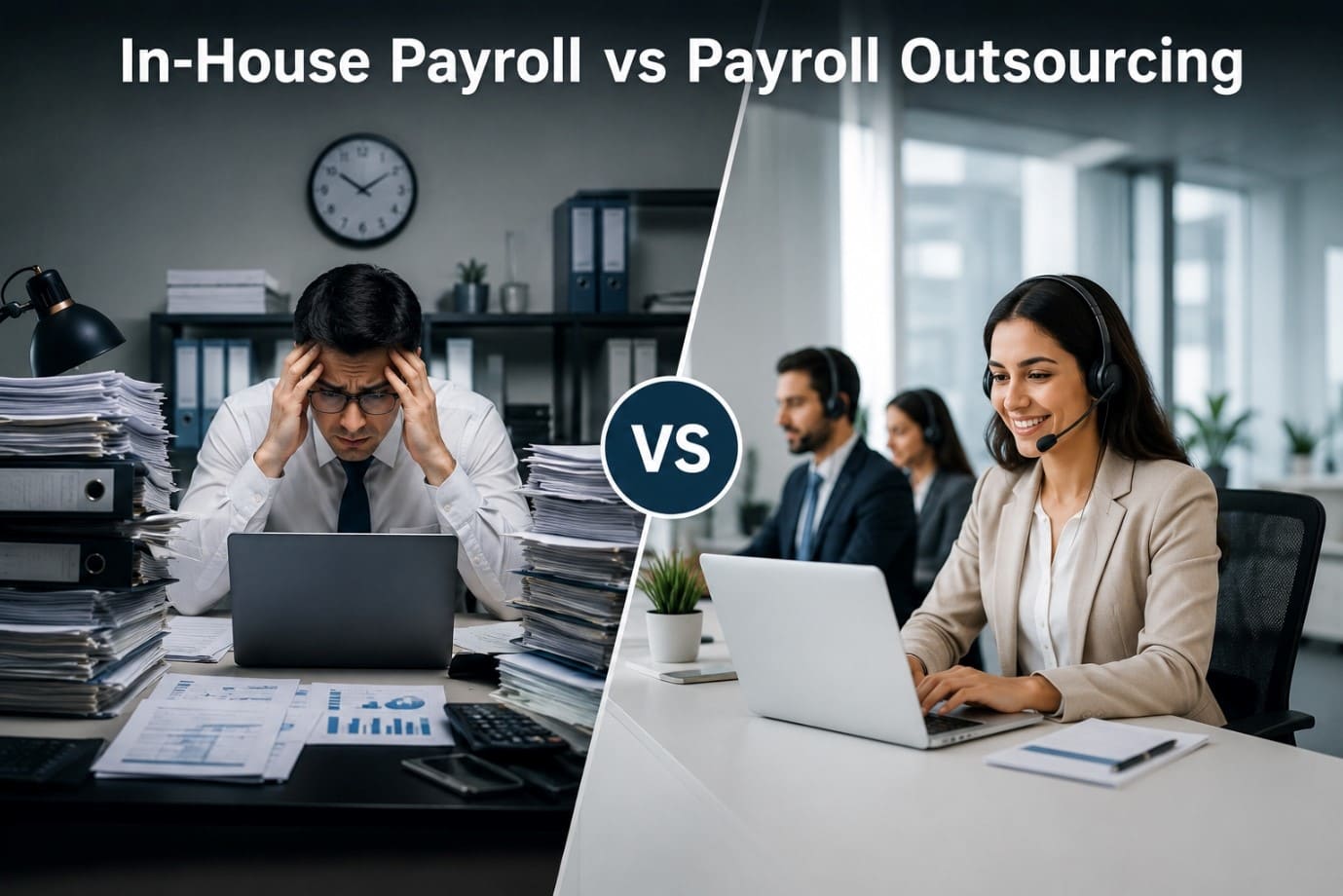

Which Option Should Businesses Choose?
For most modern businesses, payroll outsourcing offers a more efficient, cost-effective and scalable solution than managing payroll in-house. By choosing to outsource payroll services, organizations can reduce compliance risks, improve payroll accuracy, save valuable time and focus on core business growth while experienced payroll service providers handle complex payroll operations.
Which Businesses Should Consider Payroll Outsourcing?
Payroll outsourcing is an ideal solution for businesses that want to improve payroll accuracy, maintain compliance and reduce administrative workload. While organizations of all sizes can benefit from outsourcing payroll services, it is particularly valuable for businesses experiencing growth or managing complex payroll requirements.
- Start-ups: These often operate with limited resources and lean teams. By choosing to outsource payroll services, founders can focus on business growth while experienced payroll service providers manage salary processing and compliance requirements.
- SMEs: For SMEs, managing payroll internally can be both time-consuming and costly. Payroll services for small business provide access to professional expertise and scalable solutions without the need for dedicated payroll infrastructure.
- Growing Enterprises: As employee headcount increases, payroll complexity grows. Businesses that outsource payroll processing can efficiently manage larger workforces while minimizing payroll mistakes and compliance risks.
- Multi-Location Businesses: Organizations operating across multiple locations must comply with varying payroll and labour regulations. Payroll and outsourcing strategies help standardize payroll processes and ensure compliance across different regions.
- Companies Expanding Rapidly: Rapidly expanding businesses require scalable payroll systems that can adapt to changing workforce requirements. Understanding how payroll outsourcing works enables these organizations to streamline payroll operations and support growth effectively.
Conclusion:
As businesses continue to grow and regulatory requirements become more complex, payroll outsourcing has emerged as a practical and strategic solution for managing payroll efficiently. Throughout this blog, we have explored how professional payroll service providers help organizations simplify payroll administration, ensure statutory compliance, reduce payroll mistakes and improve overall operational efficiency. From salary processing and tax management to reporting and compliance monitoring, modern payroll outsourcing solutions provide comprehensive support that enables businesses to manage payroll with greater accuracy and confidence.
By choosing to outsource payroll services, businesses can benefit from accurate salary processing, timely statutory compliance, reduced administrative burdens and enhanced data security. Professional payroll service providers leverage advanced technology and expertise to manage payroll functions efficiently, helping organizations avoid costly errors and compliance penalties. Whether it is handling salary calculations, tax deductions, statutory filings or reporting, modern payroll outsourcing solutions provide end-to-end support tailored to business needs.
For start-ups, SMEs, and growing enterprises, payroll services for small business offer a cost-effective way to access specialized payroll expertise without investing in dedicated payroll infrastructure. Understanding how payroll outsourcing works demonstrates how businesses can simplify payroll administration while ensuring accuracy and regulatory compliance. Organizations that outsource payroll processing can also free up valuable internal resources, allowing HR and management teams to focus on strategic priorities rather than routine payroll tasks.
Ultimately, outsourcing payroll services is more than an operational decision, it is a strategic business investment. By adopting effective payroll and outsourcing practices and partnering with experienced payroll service providers, businesses can focus on innovation, expansion and long-term growth while payroll experts manage the complexities of payroll operations.
For more information, go to our Homepage.
Frequently Asked Questions (FAQs)
Q1.How does payroll outsourcing work?
A. Understanding how payroll outsourcing works is simple. Businesses share employee and payroll-related data with experienced payroll service providers, who then manage payroll calculations, salary processing, statutory filings, compliance checks, payslip generation and reporting. Modern payroll outsourcing solutions use automated systems to ensure accuracy and efficiency throughout the payroll cycle.
Q2. Why should businesses outsource payroll services?
A. Many businesses choose to outsource payroll services because managing payroll internally can be time-consuming and prone to errors. Payroll outsourcing helps organizations improve compliance, reduce payroll risks, save costs and gain access to specialized payroll expertise without investing in an in-house payroll team.
Q3. Are payroll services for small business worth the investment?
A. Yes. Payroll services for small business provide cost-effective access to professional payroll management, compliance support and payroll technology. By leveraging payroll outsourcing solutions, small businesses can avoid hiring dedicated payroll staff while ensuring accurate and compliant payroll operations.
Q4. What services are included in payroll outsourcing solutions?
A. Most payroll outsourcing solutions include salary processing, attendance management, leave tracking, tax calculations, EPF and ESI compliance, TDS management, payslip generation, payroll reporting and statutory filings. Businesses that outsource payroll services receive end-to-end payroll support from experienced professionals.
Q5. What is the difference between payroll and outsourcing and in-house payroll management?
A. The primary difference between payroll and outsourcing and in-house payroll management lies in expertise, cost and efficiency. In-house payroll requires dedicated staff, software and compliance management, whereas payroll outsourcing provides access to specialized experts, advanced technology and streamlined payroll processes at a lower overall cost.


Leave A Comment